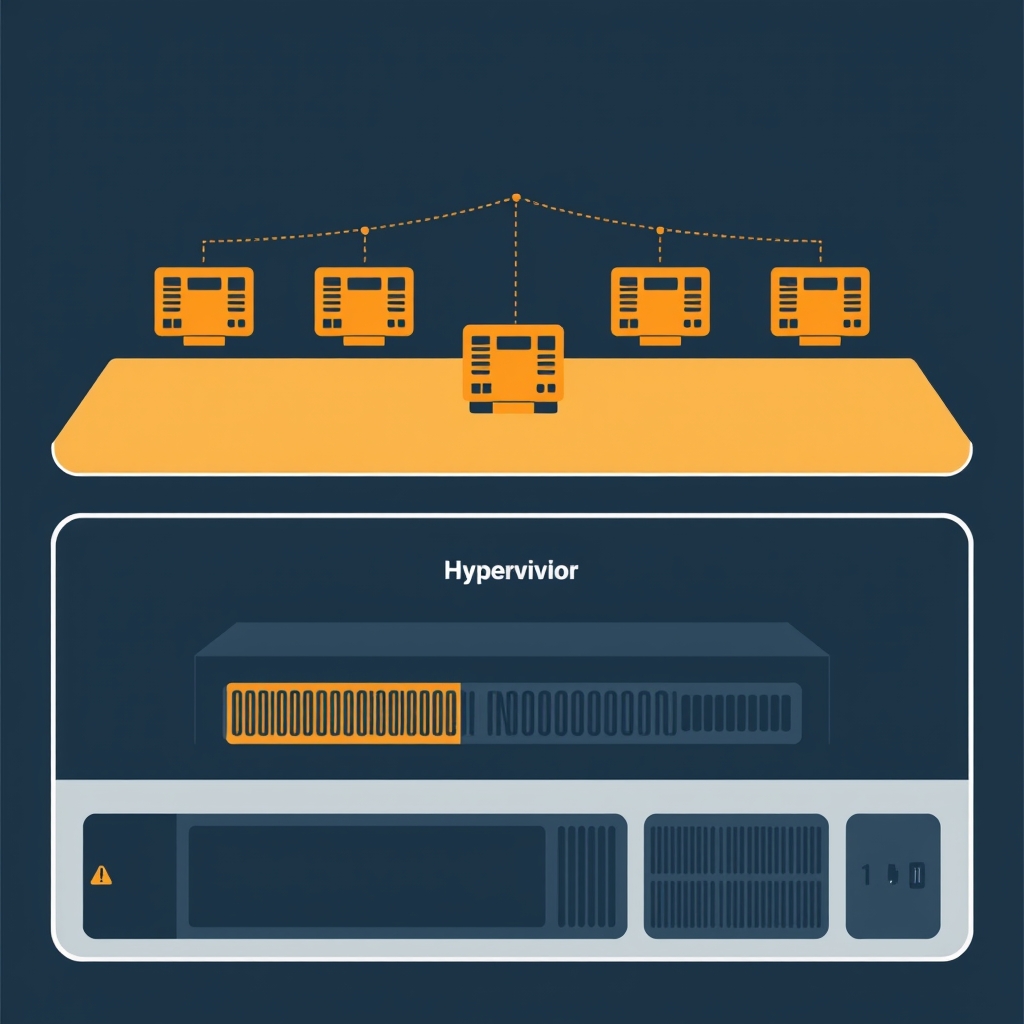
How Hypervisors Virtualize Hardware and Keep Virtual Machines Isolated
A hypervisor is the software that makes a single physical server behave like many separate machines. This guide breaks down how it partitions CPU, memory, and devices, what 'Type 1' and 'Type 2' mean, and where the security model holds (and where it's fragile).
A hypervisor — also called a virtual machine monitor (VMM) — is the software that lets several logically independent machines share one physical server. It presents each virtual machine (VM), or guest, with its own CPU, memory, storage, and network interfaces, while the physical hardware underneath is the host. The whole point: run many isolated environments on a single box, so cloud providers, data centers, and developers can share expensive infrastructure.
What a hypervisor actually does
At its core, a hypervisor mediates every request between a guest OS and the physical hardware. It allocates resources, schedules which guest gets to use the CPU and for how long, and enforces strict boundaries so one guest cannot read or write another guest's memory or devices. Without good partitioning, two VMs on the same server would be able to see each other's data; with it, each guest genuinely behaves as if it sits on a dedicated machine, isolated from its neighbors.
Type 1 vs. Type 2
There are two broad architectures. A Type 1, or bare-metal, hypervisor runs directly on the hardware — this is the model used by VMware ESXi, Microsoft Hyper-V, and KVM. A Type 2, or hosted, hypervisor runs on top of an existing general OS (think VirtualBox or VMware Workstation), which simplifies local development but adds a performance and attack-surface layer. Bare-metal hypervisors are the workhorse of the cloud because there is no intervening OS to manage — the hypervisor itself is the kernel.
How isolation is enforced
- Memory isolation: The hypervisor maps each guest into its own protected address space so one VM cannot directly read another VM's RAM.
- CPU scheduling and instruction isolation: The hypervisor timeslices the processor and controls which instructions each guest may execute, redirecting interrupt handling to the right partition.
- Device isolation: DMA transfers and device interrupts are virtualized and fenced so a guest only ever sees the virtual devices explicitly assigned to it.
- Communication control: Network and storage buses are multiplexed, so guests can be kept fully encapsulated from each other and from the host.
Why hardware virtualization support matters
Early hypervisors faked hardware by translating guest instructions in software, which was slow. Modern CPUs ship hardware assist — Intel VT-x and AMD-V (“AMD Virtualization”) — that let the hypervisor run guests almost at native speed. This hardware support is what makes dense, multi-tenant cloud servers practical, and it is why the hypervisor must run in a privileged, protected mode of the processor rather than as an ordinary application.
The security model (and where it's fragile)
A hypervisor defines the trust boundary for everything above it, so it is a high-value target. The threat model includes VM-escape bugs (a guest crossing into the hypervisor or another guest), side-channel attacks that leak data across cores, and hypervisor flaws that hand an attacker full control of the host. That is why cloud operators invest heavily in hypervisor hardening, and why the security of the virtualization layer is now a first-class discipline — not an afterthought.
What this means for you
Hypervisors are the invisible foundation under nearly every cloud VM and server you touch. Understanding that they enforce isolation by mediating every CPU, memory, and device request helps you reason about your security boundary, and about why bugs in this layer can expose every tenant on the same machine at once.
For a deeper look, the NIST Guide to Security for Full Virtualization Technologies (SP 800-125) is the standard reference, and vendor white papers on bare-metal hypervisors detail how instruction, memory, and device isolation are actually enforced in practice. The short version: the hypervisor is the referee of the entire server, and its security is the security of multi-tenant infrastructure.
- NIST — Guide to Security for Full Virtualization Technologies (SP 800-125)
- VMware — Security of the VMware vSphere Hypervisor
- Microsoft — Hyper-V Architecture
Sources: NIST SP 800-125: Guide to Security for Full Virtualization; VMware vSphere Hypervisor Security White Paper; Microsoft: Hyper-V Architecture.
Corrections: Report an error at corrections@wireshaman.com.